
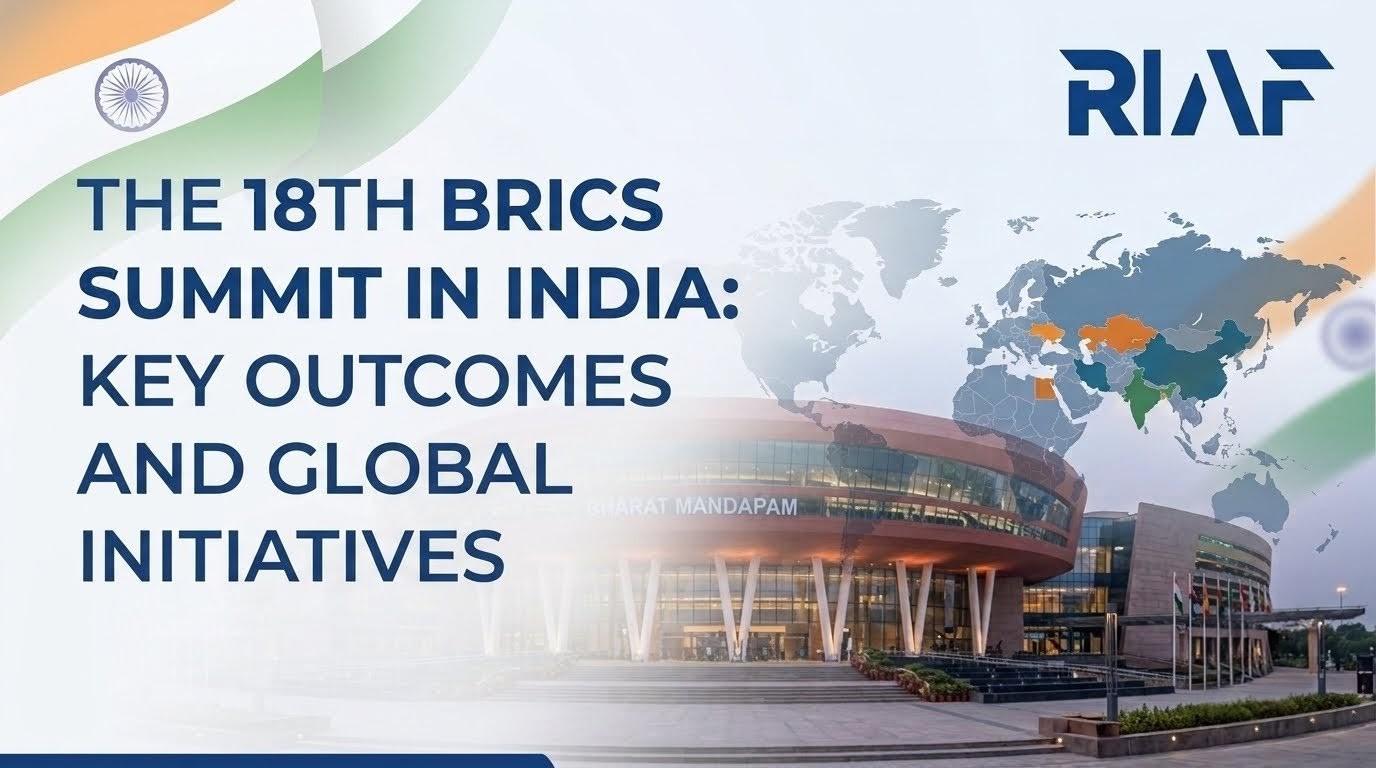
The eighteenth summit of the BRICS economic bloc, held in New Delhi, India, under the chairship of the host nation, marks a decisive milestone in the evolution of South-South cooperation. Centered on the official theme of building for resilience, innovation, cooperation, and sustainability, the high-level meeting brought together heads of state and delegates from member nations, expanded partner countries, and international organizations at the Bharat Mandapam. This gathering carries historical weight, as it coincides with the twentieth anniversary of the formation of the BRICS grouping. The proceedings concluded with the unanimous adoption of the landmark New Delhi Declaration, reflecting a joint commitment to restructuring contemporary global governance and advancing pragmatic developmental goals across the Global South. Through hundreds of preparatory sectoral meetings hosted across numerous Indian cities throughout the year, the chairship successfully steered the expanded international forum toward tangible institutional outcomes.
A central pillar of the deliberations focused on comprehensive financial integration and the mitigation of macroeconomic vulnerabilities affecting emerging markets. The summit prioritized the expansion of local currency trade mechanisms and cross-border financial settlement interoperability. Through the continued work of the BRICS Payment Task Force, member states sought to reduce transactional costs and reliance on external monetary architectures without establishing a single monetary union. Parallel to currency mechanics, the New Development Bank was explicitly mandated to expand its portfolio of local currency loans to finance vital national infrastructure. Member states also deliberated on establishing a new investment platform designed to catalyze capital flows into high-impact developmental projects. Furthermore, targeted support for micro, small, and medium enterprises was institutionalized, recognizing these commercial entities as primary engines for employment, trade, and economic resilience.
The summit made substantial strides in structural trade facilitation, customs harmonization, and global value chain stabilization. Addressing the rise of unilateral economic restrictions, protectionist trade policies, and non-tariff barriers, the summit declaration reaffirmed support for an equitable, open, and rules-based international trade system anchored by the World Trade Organization. To streamline cross-border movement of goods and combat economic malfeasance, leaders launched the Tax Cross-Learning Lab alongside an updated action plan for authorized economic operators. These administrative instruments seek to standardize trade procedures, dismantle illicit smuggling corridors, and reduce logistics overheads. Concurrently, the alignment of national manufacturing agendas aims to build secondary domestic processing capabilities, allowing developing nations to shift away from exporting unprocessed raw materials toward higher-value industrial output.
Technological equity and digital public infrastructure emerged as distinct focal points of India's leadership agenda. Member countries formally approved the creation of a centralized repository for digital public infrastructure to share open-source, scalable digital goods. This initiative enables participating states to deploy robust systems for digital identification, electronic payments, and public service management without becoming dependent on monopolistic tech corporations. Space technology cooperation was similarly broadened through the expansion of the joint remote sensing satellite constellation and the establishment of foundational terms for a dedicated space council. By democratizing access to earth observation data, the bloc seeks to optimize land use, improve agricultural yield forecasts, monitor environmental degradation, and coordinate response strategies for sudden natural disasters.
Environmental sustainability, energy transitions, and infrastructure resilience received systematic attention throughout the sessions. Member states instituted a Digital Centre of Excellence for Smart Grids to optimize the integration of variable renewable energy sources using advanced analytics. In the transportation sector, leaders established a dedicated forum for sustainable aviation fuels alongside a specialized urban mobility hub, aligning infrastructure planning with long-term carbon reduction targets. Strategic natural resource security was framed around critical minerals and sustainable forest management. The bloc adopted unified principles for integrated landscape-based greening and wildfire management, aiming to protect essential carbon sinks, combat desertification, and bolster rural community adaptation against severe ecological disruptions.
Agriculture, food security, and collective health security formed an integral part of the summit's comprehensive social agenda. Member nations committed to strengthening regional agricultural supply networks to protect vulnerable populations from market volatility and geopolitical disruptions. Collaborative frameworks were endorsed to advance agricultural research, soil health restoration, and water resource conservation across diverse climatic zones. In the public health arena, the summit emphasized expanding medical research networks, sharing pharmaceutical manufacturing technologies, and building collective diagnostic capacity. These cooperative measures aim to ensure equitable access to essential vaccines, generic therapeutics, and medical counter-measures during potential global health emergencies.
Security cooperation, legal mechanisms, and international counter-terrorism standards were consolidated in the concluding negotiations. Leaders issued a unequivocal condemnation of cross-border terrorism, terror financing networks, and the provision of safe havens, specifically emphasizing the need to finalize the Comprehensive Convention on International Terrorism under the auspices of the United Nations. Legal institutionalization advanced through the creation of an expert network and repository designed to trace fugitive economic offenders. This legal architecture will aid member states in denying safe havens to financial criminals, tracking illicit capital flows across jurisdictions, and facilitating the legal recovery and repatriation of stolen national assets.
The broader governance vision articulated in the New Delhi Declaration focuses on reforming traditional international bodies to reflect twenty-first-century realities. Member countries called for structural reforms within the United Nations Security Council, the International Monetary Fund, and the World Bank to increase the voting weight and decision-making authority of developing nations. The declaration explicitly endorsed expanded African representation within international security structures and supported the ongoing diplomatic initiatives of emerging powers. Regarding active global conflicts, the leaders advocated for diplomatic settlements, maximum restraint, the preservation of civilian life, and unhindered humanitarian access in line with international law.
Human capital development and people-to-people exchanges served as the final operational component of the summit outcomes. The launching of a dedicated capacity-building network titled BRICS CONNECT aims to enhance professional skills training, adapt educational frameworks to automated industries, and address legal protections for gig workers across member states. Cultural collaboration was formalized through mechanisms such as a shared registry for artists, designed to protect intellectual property rights and foster cross-cultural exchange. By integrating economic frameworks, environmental initiatives, digital infrastructure, and institutional reforms, the summit hosted by India reinforced the role of BRICS as a constructive, highly structured forum driving multipolar stability and sustainable human development.
References
https://www.pib.gov.in/PressNoteDetails.aspx?NoteId=159946&ModuleId=3®=3&lang=1