
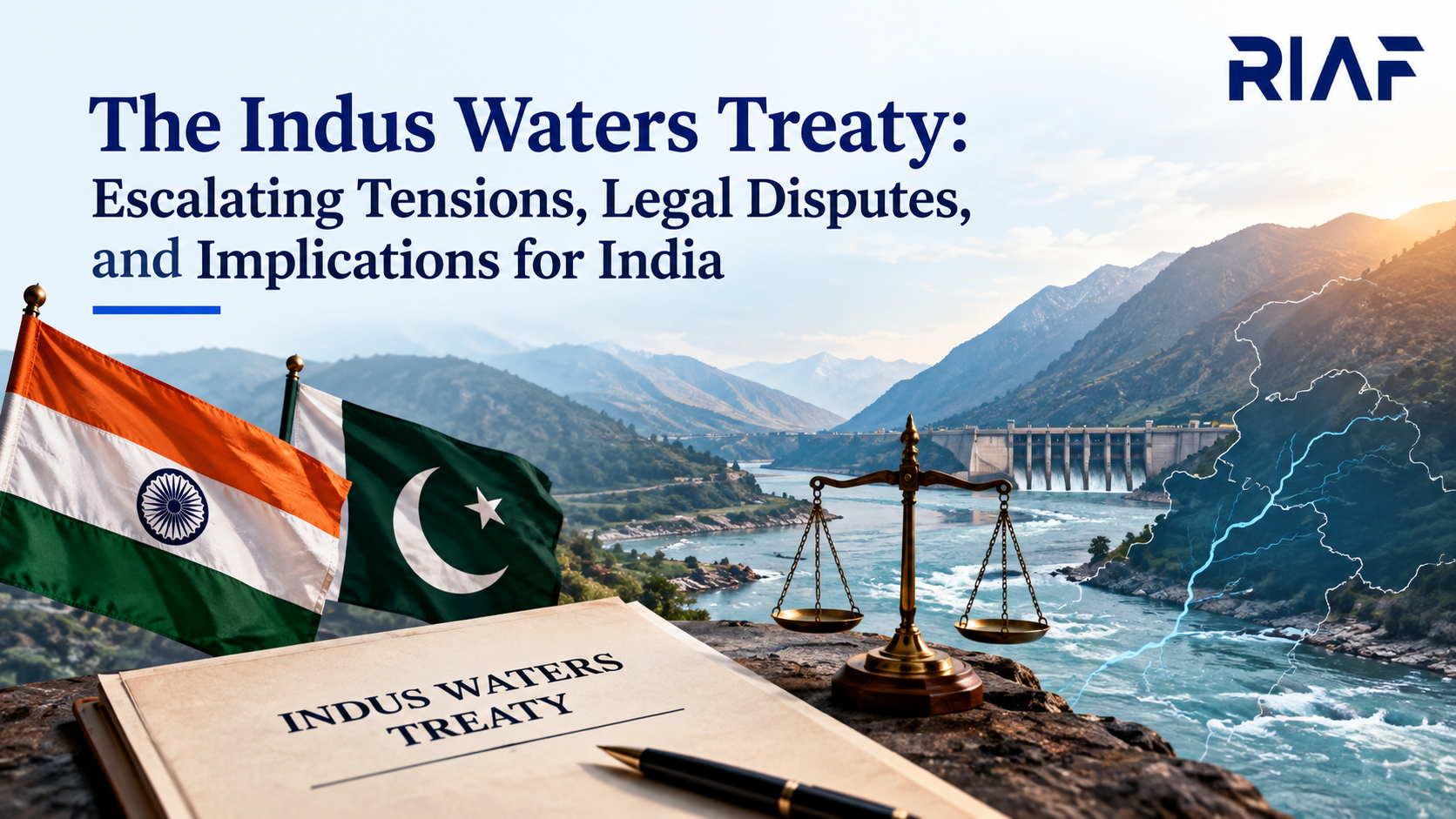
The Indus Waters Treaty, signed in 1960 under the aegis of the World Bank, stands as one of the most enduring transboundary water-sharing agreements in modern history. Negotiated between Indian Prime Minister Jawaharlal Nehru and Pakistani President Ayub Khan, the treaty established a structured framework for managing the vast Indus River system, which originates in the Himalayas and flows across the Indian subcontinent before discharging into the Arabian Sea. Under the provisions of this historic accord, the eastern rivers, comprising the Sutlej, Beas, and Ravi were allocated for exclusive use by India, while the western rivers, comprising the Indus, Jhelum, and Chenab were designated primarily for Pakistan. Because the western rivers flow through Indian-administered territories prior to entering Pakistan, the treaty granted India limited rights to utilize these waters for non-consumptive purposes, such as run-of-the-river hydroelectric projects, subject to strict technical and structural guidelines.
For more than six decades, the treaty operated with remarkable resilience, surviving multiple armed conflicts, political standoffs, and fluctuating diplomatic relations between the two neighboring nations. The bilateral body established under the accord, known as the Permanent Indus Commission, maintained regular technical exchanges, shared seasonal flow data, and facilitated routine field inspections to resolve operational differences. Over time, however, structural friction began to emerge regarding Indian infrastructure initiatives on the western rivers, notably the Kishenganga project on the Kishanganga River (a tributary of the Jhelum) and the Ratle project on the Chenab River. While India maintained that these run-of-the-river hydroelectric installations complied fully with the design criteria outlined in the treaty, Pakistan consistently raised objections, alleging that the structural designs allowed India potential control over downstream flow rates, thereby threatening Pakistani agricultural and water security.
The procedural mechanism for dispute resolution became a central point of contention when Pakistan sought international intervention. The treaty specifies a tiered dispute resolution architecture, progressing from the Permanent Indus Commission to a Neutral Expert for technical differences, and ultimately to a Court of Arbitration for broader legal disputes. In response to Pakistani objections, India requested the appointment of a Neutral Expert to resolve technical engineering queries, whereas Pakistan pursued the constitution of a Court of Arbitration at the Permanent Court of Arbitration in The Hague. India objected strongly to the simultaneous activation of both mechanisms, arguing that parallel proceedings risked producing contradictory legal findings and undermined the hierarchical integrity of the treaty. Consequently, India refused to participate in the proceedings of the Court of Arbitration, maintaining that the court lacked proper jurisdiction and that the tribunal was improperly constituted.
Diplomatic relations deteriorated sharply following a severe security incident in April 2025, when a deadly militant attack targeting civilians occurred in Indian-administered Kashmir. Asserting that cross-border terrorism violated the fundamental premises of peaceful cooperation, the Indian government announced that it was placing the Indus Waters Treaty in abeyance. New Delhi declared that normal treaty operations, routine data sharing, and joint commission meetings would remain suspended until Pakistan credibly and irrevocably ceased its support for cross-border militancy. This unilateral decision marked an unprecedented departure from decades of practice, effectively freezing the formal administration of the water-sharing architecture.
In response to India placing the accord in abeyance, Pakistan appealed to the Permanent Court of Arbitration at The Hague to issue a definitive ruling on the legal validity of India's stance. In September 2026, the Court of Arbitration issued a unanimous ruling rejecting India's position, holding that the treaty remained fully binding and operational under international law. The court concluded that unilateral suspension based on arguments of national sovereignty, security concerns, or environmental changes was impermissible under the statutory text of the accord, and affirmed that India remained bound by its treaty obligations. Pakistan welcomed the judgment as an authoritative vindication of international legal norms, while Prime Minister Shehbaz Sharif and Pakistani officials reiterated that downstream water security constituted an existential issue and a strategic red line for their nation. Conversely, the Indian Ministry of External Affairs promptly rejected the ruling, reiterating its long-standing position that the Hague court was illegally constituted, lacked jurisdiction, and that the treaty would remain suspended pending concrete action against cross-border terrorism.
The current legal and diplomatic impasse carries profound geopolitical and strategic implications for India. From a diplomatic perspective, India's outright rejection of the Court of Arbitration's ruling reinforces its firm commitment to a bilateral resolution framework, signaling that external judicial forums cannot override core national security priorities. By linking the operation of the treaty directly to cross-border terrorism, New Delhi has altered the traditional boundary between transboundary water management and national defense strategy. This posture establishes a strong precedent that bilateral treaties depend upon the maintenance of basic security conditions and peaceful coexistence.
From a hydrological and technical standpoint, the suspension of the treaty provides India with greater flexibility to expedite its domestic infrastructure projects along the western rivers. Unencumbered by the requirement to share routine design specifications or submit to technical inspections by Pakistani commissioners, Indian authorities can move forward with the planning and construction of run-of-the-river hydroelectric facilities designed to meet the growing energy and infrastructure demands of the region. This policy stance allows India to maximize its permissible water usage for irrigation and power generation within the technical boundaries of its geographical territory.
However, the ongoing suspension also introduces complex long-term challenges for India on the international stage. Maintaining a firm stance against an international arbitral award requires sustained diplomatic efforts to explain India's legal position to the global community, particularly regarding the jurisdiction of international courts and the necessity of linking treaty obligations to security imperatives. Furthermore, the complete breakdown of routine data-sharing mechanisms between upstream and downstream states creates operational uncertainties during extreme weather events. In the absence of real-time hydrological data exchanges, managing heavy monsoon flooding or seasonal droughts becomes significantly more difficult for the entire river basin, potentially compounding ecological and regional security risks.
The dispute over the Indus Waters Treaty reflects a broader shift in how transboundary natural resources are managed in regions characterized by intense security challenges. By maintaining that the treaty remains in abeyance while rejecting external arbitration, India has redefined the terms of its water engagement with Pakistan. The long-term stability of the region will depend on whether a functional framework for technical cooperation and security dialogue can eventually be restored, or whether the management of the Indus basin will continue to be governed by unilateral policies and strategic deterrence.
References