
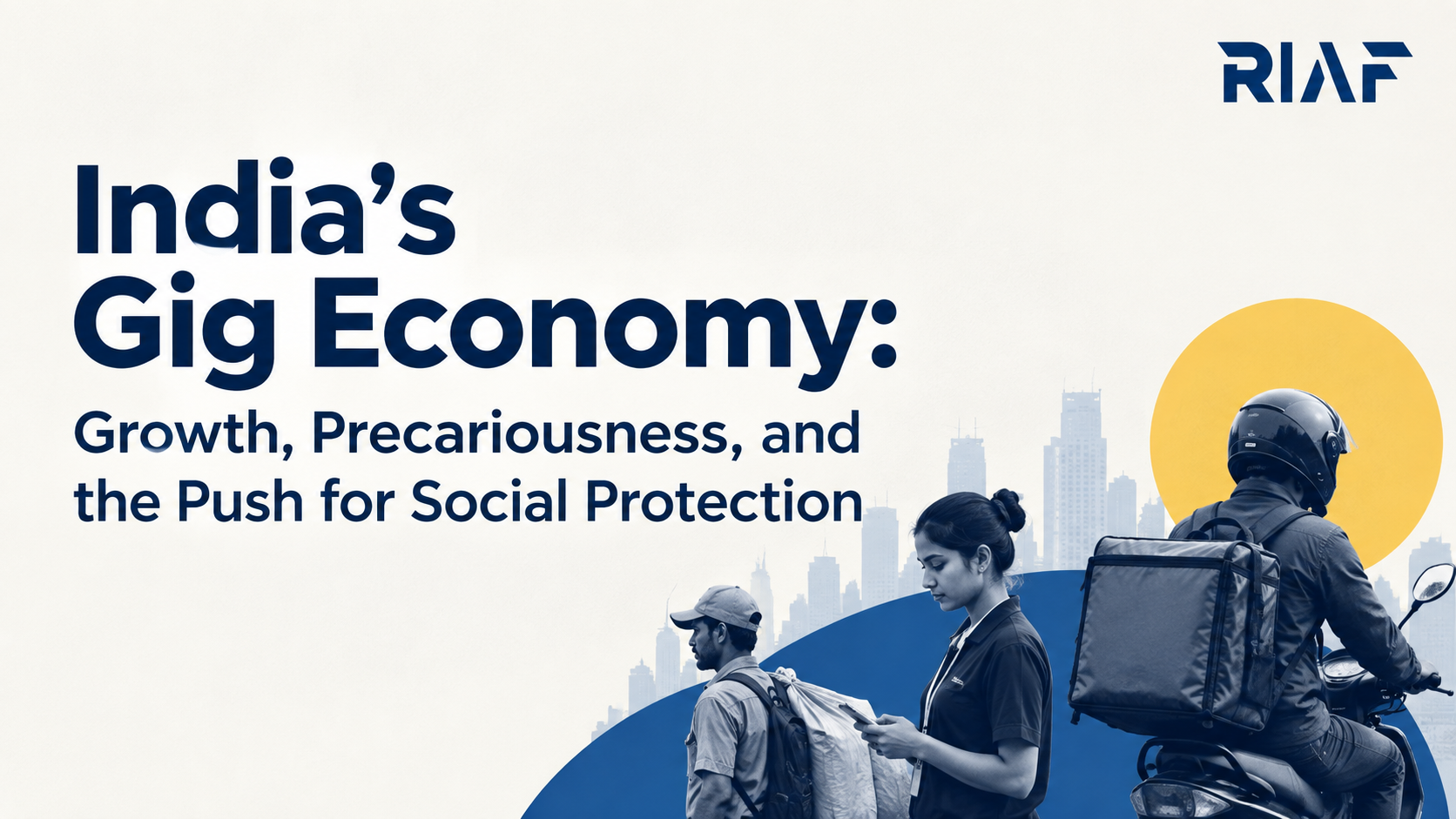
The contemporary Indian labor market is undergoing a fundamental structural transformation driven by the rapid expansion of the platform economy. A gig worker is defined as a flexible worker who performs task-based jobs, short-term assignments, or platform-driven services without a traditional long-term employer-employee relationship. These individuals range from ride-hailing drivers and food delivery personnel to freelance professionals operating through digital platforms. The official legislative recognition of this workforce was codified under the Code on Social Security in 2020, which distinctively recognized gig and platform workers as an independent category of labor requiring custom welfare interventions. Despite this formal legal classification, defining and protecting gig workers in practice remains a complex challenge, as their work dynamics lie entirely outside the traditional frameworks of salaried employment, fixed hours, and guaranteed social benefits.
The trajectory and structural dynamics of India's gig economy experienced a substantial shift following the year 2020. The onset of the COVID-19 pandemic accelerated consumer reliance on digital services, creating a massive reliance on delivery workers, urban ride-hailing services, and household service providers. According to estimates by NITI Aayog from its 2022 report titled India's Booming Gig and Platform Economy, the gig workforce stood at approximately 77 lakh in the financial year 2020-21. This number was projected to expand steadily to 1.27 crore by 2024-25 and is forecasted to reach 2.35 crore by the period 2029-30, accounting for a significant portion of the non-agricultural workforce. However, data from the Periodic Labour Force Survey and recent registrations suggest that the overall pool of gig workers could potentially exceed two crore workers, reflecting an extraordinary growth rate driven by urban consumer demand and platform expansion.
Despite this rapid quantitative growth, a persistent gap remains between the total estimated number of gig workers and those integrated into public protection systems. The government introduced the unified e-Shram portal to map unorganized labor across the nation, aiming to track gig workers and deliver targeted social security benefits. By late January 2026, e-Shram portal registrations for gig workers reached 8.58 lakh. While this represents a notable surge in registrations compared to earlier years, fueled largely by promises of health coverage and social safety nets announced in recent national budgets, the data underscores a critical disparity. Less than twenty percent of the estimated gig workforce is registered on the primary government platform, leaving four out of every five gig workers outside the direct reach of government policies and institutional support systems.
Geographic and sector-specific distributions reveal significant unevenness in how gig work manifests and how registration policies are adopted across India. Sectorally, registrations on the e-Shram portal demonstrate that the food industry accounts for the largest share of gig workers at 32.8 percent, closely followed by the automobile and transportation sector at 25.4 percent. Other notable sectors include domestic and household work at 9.9 percent, agriculture at 3.4 percent, construction at 3.6 percent, and various other services making up the remaining 24.9 percent. Geographically, registration data highlights severe regional variations. States like Maharashtra lead the portal registrations with over 1.34 lakh workers, followed by Uttar Pradesh with 1.30 lakh, Bihar with 1.09 lakh, West Bengal with over 54 thousand, and Delhi with nearly 49 thousand workers. Conversely, states with significant urban centers and high platform density, such as Tamil Nadu, Telangana, and Kerala, show surprisingly low portal registration numbers, indicating that administrative reach and worker awareness remain highly uneven across state borders.
Beyond administrative enumeration, the day-to-day existence of gig workers is defined by severe job insecurity, income volatility, and physical risks. Gig workers operate without standard employment contracts, paid leave, sick pay, or retirement benefits. Income is determined dynamically by platform algorithms, order frequency, and variable incentive schemes, leaving workers exposed to sudden earnings fluctuations. Job security is virtually non-existent, as workers face the constant threat of account suspension or deactivation based on customer reviews or algorithmic metrics, often without access to a formal grievance redressal mechanism.
Physical safety and hazardous working conditions present another major vulnerability for platform personnel. A significant portion of the platform workforce operates in high-risk environments such as urban roads and severe weather conditions. Recent traffic safety and urban transportation studies in major metropolitan areas like Delhi reveal that one in three gig workers feels consistently unsafe on the roads. Delivery personnel faced with tight delivery deadlines, traffic congestion, extreme heatwaves, and severe atmospheric pollution are particularly vulnerable to road accidents and long-term health complications. The intense pressure to maintain high speed for task completion exacerbates exposure to hazardous road conditions, while institutional safety nets like comprehensive accident insurance and health coverage remain difficult to access or poorly implemented.
Recognizing these systemic vulnerabilities, the central government under Union Minister Dr. Mansukh Mandaviya has reaffirmed its commitment to establishing a secure, dignified, and better working environment for platform workers. The Ministry of Labour and Employment has formed dedicated committees and initiated consultative meetings with platform workers' associations to build comprehensive social security frameworks. Measures are underway to ensure the mandatory onboarding of aggregators onto the e-Shram portal, creating a unified digital mechanism to extend life insurance, disability cover, health benefits, and maternity support to workers who were historically excluded from formal welfare frameworks.
To fund these welfare initiatives, policymakers and economic analysts are actively debating the mechanism for levying contributions from platform aggregators. Under the Code on Social Security, aggregators are required to contribute toward a social security fund. However, the precise mathematical formula for calculating this levy remains a subject of intense evaluation. Analysts have pointed out that a transaction-based or payout-linked levy, which imposes a flat percentage on individual transaction values, creates an unequal burden across different platform business models. For example, high-frequency, low-ticket businesses like ride-hailing services process millions of daily transactions at small amounts. Under a payout-linked formula, a ride-hailing platform could face liability that vastly exceeds its annual revenue, severely penalizing low-margin or zero-commission models that pass maximum earnings directly to workers.
In contrast, a turnover-linked formula is increasingly viewed by economic analysts as a far more proportionate and equitable approach. Under a turnover-based model, aggregator contributions are calculated as a small percentage of the company's overall annual turnover,capped relative to total worker payouts. This structure aligns welfare contributions directly with the actual economic capacity and scale of the aggregator rather than the frequency or structure of individual transactions. A turnover-based levy ensures that large, high-revenue platforms contribute in proportion to their total business volume, preventing market distortions while establishing a predictable, sustainable source of funding for gig worker welfare programs.
The evolution of India's gig economy presents a paradoxical landscape of dynamic job creation and precarious labor conditions. While digital platforms offer flexible earning opportunities to millions, the absence of basic social security, poor road safety, and slow registration coverage highlight the urgent need for structural reform. Translating policy intent into meaningful impact requires bridging the digital registration gap on platforms like e-Shram, establishing clear occupational safety standards, and implementing a fair, turnover-linked funding mechanism. Balancing innovation and platform growth with robust, legally binding labor protections is essential to ensure that the millions of workers powering the digital economy receive the security, dignity, and economic stability they deserve.
References: